Repair, Resurface, or Replace Your Driveway?
By Derek Garvey · Reviewed July 2026 · National planning ranges, not quotes · Questions or corrections: admin@pavingcalc.com
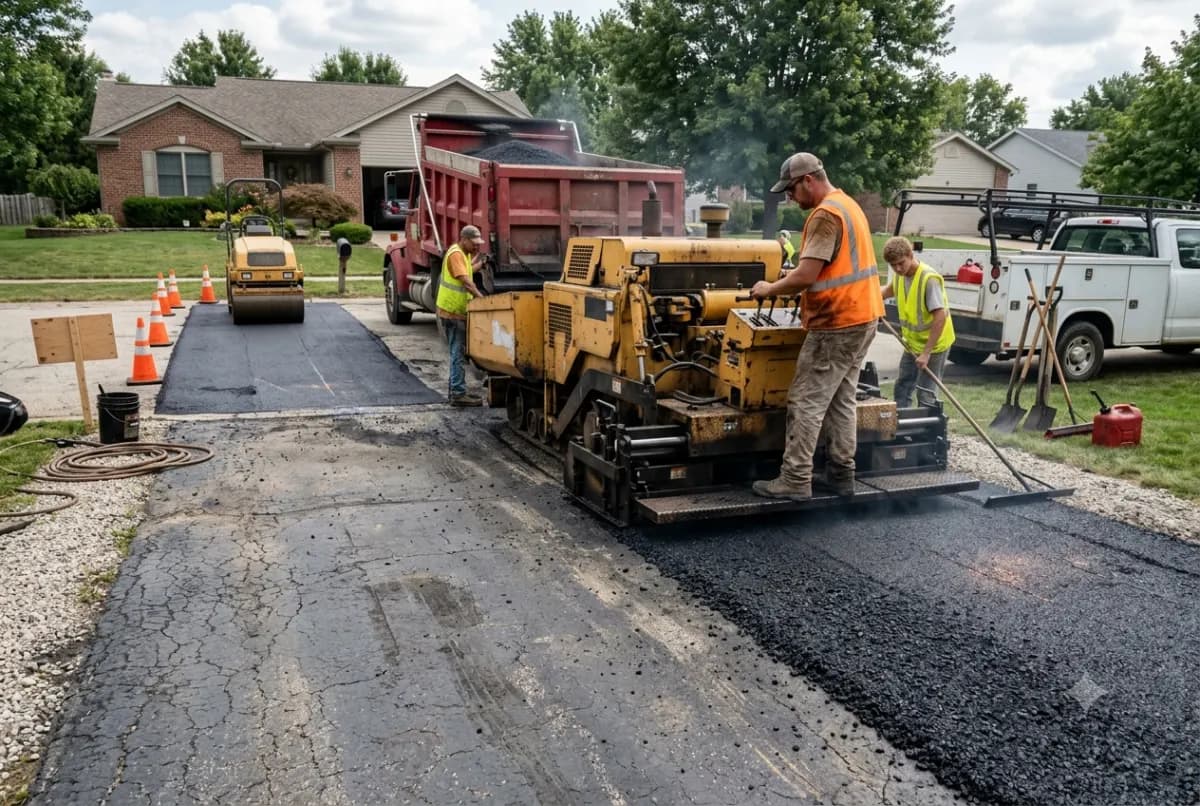
Small, isolated failures often call for a local repair. Resurfacing may make sense when the whole surface is worn but the base and drainage still work. Replacement becomes the safer choice when failures are widespread, the base moves or stays wet, or another layer of asphalt would create elevation problems.
The crack pattern tells part of the story, not all of it. Water, weak soil, thin pavement, poor compaction, roots, utilities, and heavy vehicles can produce similar-looking damage. A repair works only if it addresses the cause.
Fast decision table
| Observed condition | Likely starting point | Why |
|---|---|---|
| One or two isolated cracks | Crack treatment | Limits water entry if movement is minor |
| Local pothole with stable surroundings | Full-depth patch | Removes failed material in that area |
| Worn, oxidized surface; stable shape | Resurfacing evaluation | New surface may be supported adequately |
| Repeating cracks across much of driveway | Structural investigation | Overlay may develop reflective cracks |
| Alligator cracking | Base/drainage investigation | Often signals fatigue or loss of support |
| Deep wheel ruts | Structural investigation | May indicate unstable mix, base, or subgrade |
| Settlement at garage or street | Elevation and drainage redesign | Overlay may worsen the transition |
| Standing water or pumping after rain | Drainage/base correction | Surface treatment does not remove water |
| Many prior patches failing | Reconstruction evaluation | Repeated spot work may no longer be economical |
This table is triage, not a diagnosis. A contractor or pavement professional should inspect the site and, when needed, use cores, probes, test pits, or proof rolling.
Option 1: Localized repair
Localized work includes crack treatment, small full-depth patches, edge repair, and correction around drains or utility structures.
Repair is a good fit when:
- distress covers a small portion of the driveway.
- adjacent pavement is stable.
- water is not moving the base.
- the cause can be corrected locally.
- the remaining surface has useful life.
Ask how the patch will be cut, excavated, supported, compacted, sealed at edges, and matched to drainage. A thin surface patch placed into a deep failed hole is not equivalent to full-depth repair.
Option 2: Resurfacing or overlay
An overlay adds asphalt over an existing pavement. Milling may first remove material to restore elevations, improve bonding, or correct surface shape.
Resurfacing is more plausible when:
- the base is stable and reasonably dry.
- rutting and settlement are minor.
- failures are limited and repaired first.
- drainage can remain correct.
- garage, curb, sidewalk, and street elevations allow added thickness.
- crack-reflection risk is understood.
An overlay is not a reset button. Existing joints and cracks can move and reflect into the new surface. The proposal should identify pre-overlay repairs, cleaning, tack coat, milling, compacted thickness, joint locations, and transitions.
Option 3: Replacement or reconstruction
Replacement removes existing asphalt. Reconstruction also corrects unsuitable base or subgrade and rebuilds the pavement section.
This is often justified when:
- alligator cracking is extensive.
- areas move, pump, or stay saturated.
- deep ruts or depressions cover a large area.
- the pavement is badly broken at many locations.
- drainage or slope must be redesigned.
- added overlay thickness would trap water or create unsafe edges.
- the driveway must be widened or carry heavier vehicles.
- repeated repairs are consuming budget without solving the cause.
Demolition creates an opportunity to correct grade, drainage, soft areas, and the pavement section. It also carries uncertainty. Request written unit prices for unforeseen excavation and stone.
Read the crack pattern
Longitudinal or edge cracking
Possible causes include unsupported edges, shoulder erosion, widening joints, construction joints, frost, or traffic close to the edge. Correct the support or drainage when practical before sealing.
Transverse cracking
Temperature movement, aging, and underlying joints can create transverse cracks. A new overlay may not stop recurring movement.
Alligator cracking
Interconnected small polygons often indicate fatigue under repeated loading and insufficient support. Coating over it may darken the surface but will not restore structure.
Depressions and bird baths
Standing water may result from settlement, weak areas, bad grading, or blocked drainage. Filling only the low point can move water somewhere worse.
Raveling
Loss of surface aggregate can come from aging, mixture or construction issues, fuel, water, or wear. Mild surface aging may be maintainable; deeper loss needs evaluation.
Five tests before accepting an overlay proposal
| Check | What to look for |
|---|---|
| Drainage | Observe the driveway during or immediately after rain. Mark standing water and discharge paths. |
| Elevation | Check garage thresholds, walkways, curbs, drains, and street tie-ins. Added thickness must go somewhere. |
| Movement | Note pumping water, rocking pieces, widening cracks, or recurring settlement. |
| Extent | Map the failed square footage instead of judging from one representative photo. |
| Structure | Ask whether cores, probes, or test pits are needed to confirm pavement and base thickness. |
Budget comparison
Published national cost guides often show repair, overlay, and replacement in overlapping ranges because each job has different mobilization and preparation. A small repair can have a high unit price; a large simple overlay can have a lower one.
Compare the likely remaining value of each option with its first cost:
Annualized planning cost = project cost ÷ realistic expected service interval
This is a decision aid, not a warranty calculation. Use conservative intervals provided in writing by bidders, and consider disruption, risk, and future access.
Scope questions for contractors
- What caused the visible failure?
- How did you evaluate base and drainage?
- Which areas receive crack treatment, patching, milling, or full removal?
- What are the compacted material thicknesses?
- How will elevations change?
- Where will runoff go?
- Could existing cracks reflect through, and how is that risk handled?
- What unit prices apply if soft material is found?
- What is explicitly excluded?
- What conditions are covered by the warranty?
Common mistakes
- Selecting an overlay only because it has the lowest price.
- Sealcoating structural cracks to improve appearance before sale.
- Ignoring water at the garage or pavement edge.
- Comparing proposals with different areas and thickness assumptions.
- Allowing added pavement to bury siding, reduce curb reveal, or create a trip edge.
- Treating every crack as evidence that complete replacement is necessary.
Sources and methodology
- Illinois Asphalt Pavement Association: Driveways
- Asphalt Magazine: What makes a good asphalt driveway?
- Asphalt Magazine: Commercial and residential paving, part 2
- FHWA: Pavement design inputs and project-specific data
Editorial note: This guide supports preliminary decisions, not remote diagnosis. A site inspection is necessary before structural work.
Frequently asked questions
- Can alligator cracking be sealed?
- A coating or crack filler may temporarily cover parts of it, but widespread alligator cracking commonly points to structural fatigue or support loss. Investigate and repair the failed section.
- How much cracking is too much for an overlay?
- There is no reliable percentage that works for every driveway. Crack type, movement, base condition, drainage, elevations, and desired service life matter more than a single area threshold.
- Is milling always required before resurfacing?
- No, but it may be needed to restore elevations, remove distressed material, create a sound surface, or manage transitions. The contractor should explain why the proposed preparation is appropriate.
- Will a new overlay look uniform?
- Usually at first, but repaired areas and underlying cracks can behave differently over time. Set expectations in the proposal.