Asphalt Driveway Cost in 2026
By Derek Garvey · Reviewed July 2026 · National planning ranges, not quotes · Questions or corrections: admin@pavingcalc.com
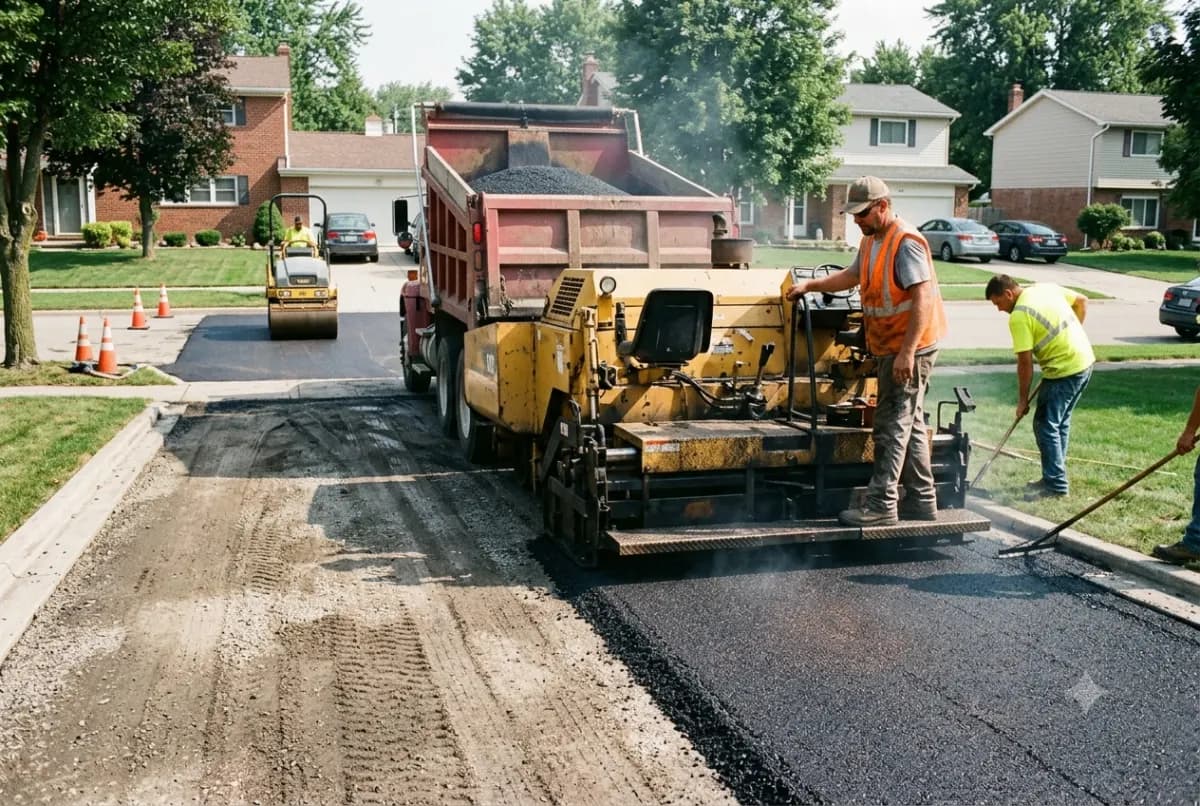
For a quick 2026 budget, use $5-$13 per square foot for a new residential asphalt driveway. Replacement projects that include demolition and disposal can reach $8-$15 per square foot. A suitable overlay may fall closer to $3-$7. These figures are planning ranges, not quotes, and local bids can land outside them.
The spread is wide for a reason. Soil, drainage, asphalt thickness, truck access, local labor, plant distance, and the size of the job all affect the price.
Use the PavingCalc asphalt calculator for a first-pass area and budget. Then compare at least three itemized local bids using the same scope.
Quick cost estimator
Multiply paved area by a realistic low and high rate:
Estimated cost = driveway square feet × installed price per square foot
| Paved area | At $5/sq. ft. | At $9/sq. ft. | At $13/sq. ft. |
|---|---|---|---|
| 400 sq. ft. | $2,000 | $3,600 | $5,200 |
| 600 sq. ft. | $3,000 | $5,400 | $7,800 |
| 800 sq. ft. | $4,000 | $7,200 | $10,400 |
| 1,000 sq. ft. | $5,000 | $9,000 | $13,000 |
| 1,500 sq. ft. | $7,500 | $13,500 | $19,500 |
The middle column is not a national average or promise. It is a scenario for comparison. A simple driveway on strong, well-drained soil may price below it. A small job with extensive excavation, poor access, drainage work, or thick pavement may price above it.
Quick estimate
Ballpark only, not a binding quote. This runs on our calculator’s working rates, so it lands tighter than the national ranges quoted above — those span every market in the country. Measure it precisely on the map →
New installation, replacement, and overlay are different jobs
New installation
This starts with soil preparation, grading, aggregate base or a full-depth asphalt design, asphalt placement, compaction, and edge finishing.
Replacement
Replacement adds saw cutting or demolition, loading, hauling, disposal, correction of failed base material, and elevation matching at the garage, street, walkways, and drainage points.
Overlay or resurfacing
An overlay places new asphalt over the existing pavement. It can save money when the structure below is reasonably stable. Widespread base failure, movement, saturated areas, or major drainage defects commonly show through again.
Ask every bidder to label the proposed scope clearly. Two bids are not comparable if one includes removal and base reconstruction while another assumes a thin overlay.
Seven factors that change asphalt driveway price
1. Finished area
Area is the starting point, but smaller jobs often cost more per square foot because mobilization, equipment transport, crew time, and minimum asphalt orders are spread over fewer square feet. Measure the full paved shape, including parking pads and turnarounds. See How to Measure Your Driveway.
2. Pavement section and compacted thickness
Price depends on the structure below the black surface. The contractor should state:
- prepared subgrade work.
- aggregate type and compacted base thickness, if used.
- asphalt mixture or lift description.
- compacted asphalt thickness.
- treatment at edges and transitions.
Illinois Asphalt Pavement Association guidance describes examples ranging from full-depth asphalt to asphalt over a compacted aggregate base. The right section depends on soil support, drainage, climate, and expected vehicles. A universal “two inches is enough” rule is not reliable.
3. Excavation and base repair
Soft soil, buried organic material, pumping stone, frost damage, or an old failed base can require undercutting and replacement. This is one of the largest budget uncertainties because the full condition may not be visible until demolition begins.
Request unit prices for unforeseen excavation, stone, geotextile, and hauling. The contract should also say who authorizes added work and how it will be documented.
4. Drainage and elevation control
Water is a pavement problem and a property problem. The driveway must shed water without sending it into the garage, foundation, neighboring property, or an unsafe icy area. Swales, drains, culverts, or elevation correction can add cost but may prevent early failure.
5. Access and geometry
Long hauls from the truck, narrow gates, overhead wires, steep grades, tight turns, islands, handwork, and many edges slow production. A large rectangle is generally more efficient than the same area broken into several small sections.
6. Asphalt supply and project timing
Asphalt plants, trucking distance, fuel, labor availability, weather, and seasonal demand affect local bids. Get date-stamped proposals and ask how long the price is valid.
7. Permits and right-of-way work
Apron replacement, curb cuts, culverts, sidewalks, or work near the street may require municipal approval. Confirm who obtains permits and whether fees, traffic control, inspections, and restoration are included.
What a complete bid should include
Use this scope checklist when comparing proposals:
| Scope item | What should be written down |
|---|---|
| Area | Approximate square footage and limits of work |
| Removal | Material, depth, hauling, disposal, and dump fees |
| Subgrade | Grading, proofing, soft-area treatment, and compaction |
| Base | Material and compacted thickness |
| Asphalt | Mix/lift description and compacted thickness |
| Drainage | Planned slopes, drains, swales, and discharge point |
| Transitions | Garage, street, curb, sidewalk, utilities, and structures |
| Edges | Edge detail and shoulder/backfill responsibility |
| Protection | Access restrictions and opening-to-traffic instructions |
| Warranty | Written coverage, exclusions, and claim process |
| Payment | Deposit, progress payments, retainage, and final payment trigger |
Costs commonly omitted from quick estimates
Budget separately when applicable for permits, utility marking beyond the public locate service, engineering, drainage structures, retaining walls, landscape restoration, gate changes, striping, heated pavement, specialty mixes, or temporary access.
A calculator cannot see poor soil, hidden drainage, asphalt-plant distance, or access constraints. Treat the result as a conversation starter.
How to reduce cost without reducing pavement quality
- Keep the layout simple and avoid unnecessary small extensions.
- Fix drainage in the design rather than paying for repeat repairs.
- Compare both the written scopes and the bottom-line prices.
- Coordinate nearby work if mobilization can be shared.
- Ask whether the contractor recommends an alternate section and why.
- Do not save money by accepting undefined thickness, weak base preparation, or payment in full before completion.
Sources and methodology
Cost ranges synthesize current national consumer estimates and are intentionally broader than any single source. Technical specifications should be finalized by the local contractor or engineer.
- Angi: Asphalt driveway cost
- HomeGuide: Asphalt driveway cost
- Illinois Asphalt Pavement Association: Driveways
- Asphalt Institute: Engineering FAQs
- FTC: How to avoid home-repair scams
Editorial note: Prices were reviewed July 21, 2026. Verify local conditions and current bids before making a purchasing decision.
Frequently asked questions
- How much does a 600-square-foot asphalt driveway cost?
- At the $5-$13 national planning range used here, about $3,000-$7,800. Removal, base repair, drainage, access, and local market conditions can put the quote outside that range.
- Is asphalt priced by square foot or ton?
- Homeowners usually receive a project or square-foot price. Contractors may buy and track asphalt by ton. Tonnage depends on area, compacted thickness, and mixture density, so a square-foot estimate should not be converted to tons without a defined pavement section.
- Does the lowest price per square foot win?
- No. First compare removal, compacted base and asphalt thickness, drainage, transitions, warranty, and payment terms. A low number attached to an incomplete scope is not a cheaper version of the same project.
- Should a new asphalt driveway be sealcoated immediately?
- No. Asphalt Institute guidance says a properly built low-volume pavement should not normally require sealcoating for roughly two to five years, depending on climate, construction, and condition. Sealcoating is not a substitute for structural repair.