Driveway Sealcoating Cost in 2026
By Derek Garvey · Reviewed July 2026 · National planning ranges, not quotes · Questions or corrections: admin@pavingcalc.com
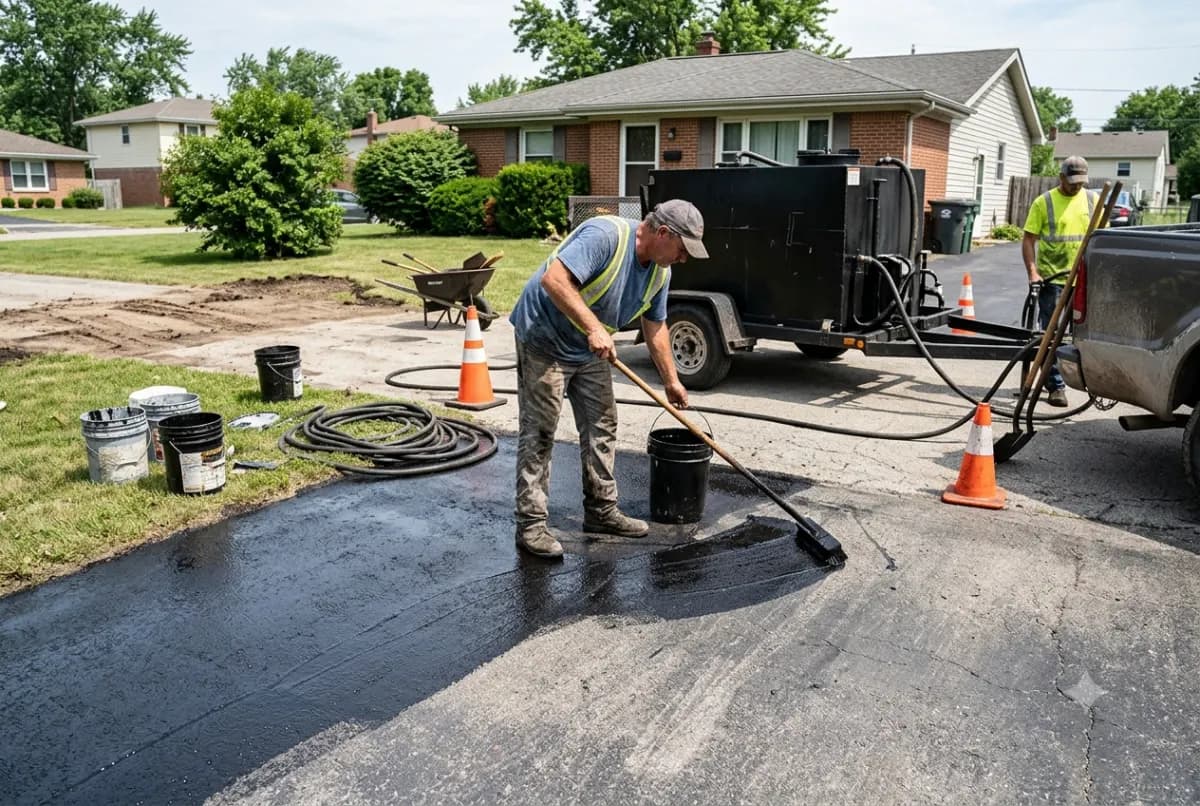
Current consumer estimates put professional driveway sealcoating around $1-$2 per square foot. That makes a 400-square-foot driveway roughly $400-$800 before repairs or unusual preparation. Small jobs may cost more per square foot because many contractors have a minimum service charge.
One correction matters more than the price table: new asphalt should not be sealed right away. The Asphalt Institute says a properly built low-volume pavement should not normally need sealcoating for roughly two to five years. Climate and pavement condition decide the timing, not an automatic calendar reminder.
Quick sealcoating budget
| Driveway area | At $1.00/sq. ft. | At $1.50/sq. ft. | At $2.00/sq. ft. |
|---|---|---|---|
| 300 sq. ft. | $300 | $450 | $600 |
| 400 sq. ft. | $400 | $600 | $800 |
| 600 sq. ft. | $600 | $900 | $1,200 |
| 800 sq. ft. | $800 | $1,200 | $1,600 |
| 1,000 sq. ft. | $1,000 | $1,500 | $2,000 |
These are calculation scenarios using a national planning range, not guaranteed prices. Many contractors have a minimum charge. Ask whether crack treatment, patching, cleaning, and multiple coats are included.
Quick estimate
Ballpark only, not a binding quote. This runs on our calculator’s working rates, so it lands tighter than the national ranges quoted above — those span every market in the country. Measure it precisely on the map →
What sealcoating can and cannot do
Sealcoating is a thin surface treatment intended to protect a sound asphalt surface from weathering and refresh its appearance. It can fill small surface voids and help slow oxidation when appropriately selected and applied.
Sealcoating does not rebuild a weak base, stop structural movement, level ruts, restore drainage, or permanently repair alligator cracking. A dark coating can temporarily hide distress without correcting it.
| Existing condition | Likely next step |
|---|---|
| Sound pavement beginning to look dry or gray | Evaluate for sealcoat |
| Isolated narrow cracks | Clean/treat cracks, then evaluate sealcoat |
| Pothole or small failed area | Full-depth patch before any coating |
| Alligator cracking or pumping | Diagnose base/drainage failure |
| Deep rutting or settlement | Structural evaluation; coating will not fix it |
| Active oil contamination | Clean/treat; verify coating compatibility |
When should a new asphalt driveway be sealed?
Do not use the common “seal it within the first year” rule as default advice. Asphalt Institute says new pavement should not need sealing and notes that a properly built driveway or low-volume lot should usually provide about two to five years of service before a sealcoat is considered. Timing varies with climate, mix quality, construction, traffic, sun exposure, and surface condition.
Signs that justify evaluation include:
- the surface looks dry or brittle.
- small interconnected surface voids are becoming visible.
- fine cracks are appearing.
- minor raveling has begun.
- an appropriate seal has not been applied for several years.
Follow the selected product’s surface-age and weather instructions. A qualified contractor should reject a surface that is too new, contaminated, wet, structurally failed, or incompatible with the product.
Product choice matters
Asphalt Institute recommends light applications of asphalt-based emulsion for driveway sealcoating and advises against coal-tar products. USGS research identifies coal-tar-based pavement sealcoat as a potent source of polycyclic aromatic hydrocarbons, or PAHs, while asphalt-based products generally have much lower PAH concentrations.
Ask the contractor to identify the exact product and provide its technical data and safety data sheets. Confirm that the product is permitted locally; some jurisdictions restrict coal-tar sealants.
Avoid treating “airport-grade” or similar marketing language as a technical specification. Product name, manufacturer, dilution, coverage rate, number of coats, aggregate/additives, surface preparation, and weather requirements are more useful.
What changes the price
Area and minimum charge
Larger simple areas can have lower unit costs. A small driveway may still require the same crew travel, setup, blower, edging, barricades, and return time.
Cleaning and preparation
Dirt, vegetation, loose aggregate, standing water, and incompatible coatings can prevent bonding. The scope should state cleaning method and how oil spots are handled.
Crack and patch repairs
Crack treatment and full-depth patching are separate processes. Ask for crack dimensions, material, and unit price. “Crack filling included” is too vague when a driveway has extensive distress.
Coats and application rate
More is not automatically better. Asphalt Institute cautions against overapplication. Require compliance with the manufacturer’s coverage rate and drying conditions.
Access, edges, and protection
Fences, landscaping, walls, garage doors, sidewalks, curbs, and decorative surfaces require handwork and masking. Confirm responsibility for overspray or tracking.
Bid checklist
Ask each contractor to provide:
- measured area.
- product manufacturer and product name.
- asphalt-emulsion or other product type.
- preparation and oil-spot treatment.
- crack-treatment and patching scope.
- number of coats and manufacturer coverage rate.
- whether material is diluted on site.
- temperature, rain, and surface-moisture limits.
- access closure and reopening instructions.
- protection of buildings, concrete, landscaping, and vehicles.
- warranty and exclusions.
Weather and reopening
Drying depends on product, temperature, humidity, shade, coat thickness, and surface condition. Do not promise a universal reopening time. Follow the manufacturer’s label and the contractor’s written instructions. Keep people, pets, irrigation, rainwater, and vehicles off the coating for the specified period.
DIY or professional application?
DIY may be reasonable for a small sound driveway when the homeowner can clean thoroughly, repair compatible cracks, follow label rates, manage weather, protect adjacent surfaces, and block access. Professional work is more appropriate when there are many cracks, oil contamination, failed areas, drainage problems, steep slopes, difficult edges, or uncertainty about the existing coating.
Material is only part of the DIY cost. Include surface preparation, tools, disposal, protective equipment, time, and the risk of applying too much or using an unsuitable product.
Sources and methodology
Asphalt Institute: Engineering FAQs · USGS: Coal-tar-based pavement sealcoat, PAHs, and the environment · Angi: Driveway sealcoating cost · HomeGuide: Driveway sealing cost · HomeAdvisor: Seal asphalt paving cost
Editorial note: Sources were reviewed July 21, 2026. Verify local product restrictions, current prices, weather requirements, and manufacturer instructions.
Frequently asked questions
- Does sealcoating make asphalt last longer?
- It can be a useful preventive-maintenance treatment for a suitable surface. It cannot compensate for poor drainage, inadequate structure, construction defects, or delayed structural repairs.
- How often should a driveway be sealcoated?
- Inspect condition rather than following an automatic annual or biennial schedule. Overapplication can create buildup and problems. Follow product guidance and reseal only when condition warrants it.
- Should cracks be sealed first?
- Cracks and failed areas should be evaluated and treated with compatible methods before the surface coating. Wide or moving cracks may signal a deeper problem.
- Is coal-tar sealcoat the same as asphalt emulsion?
- No. They use different binders and have different environmental profiles. Ask for the exact product; choose a locally permitted, appropriate non-coal-tar option.