How to Hire a Paving Contractor
By Derek Garvey · Reviewed July 2026 · National planning ranges, not quotes · Questions or corrections: admin@pavingcalc.com
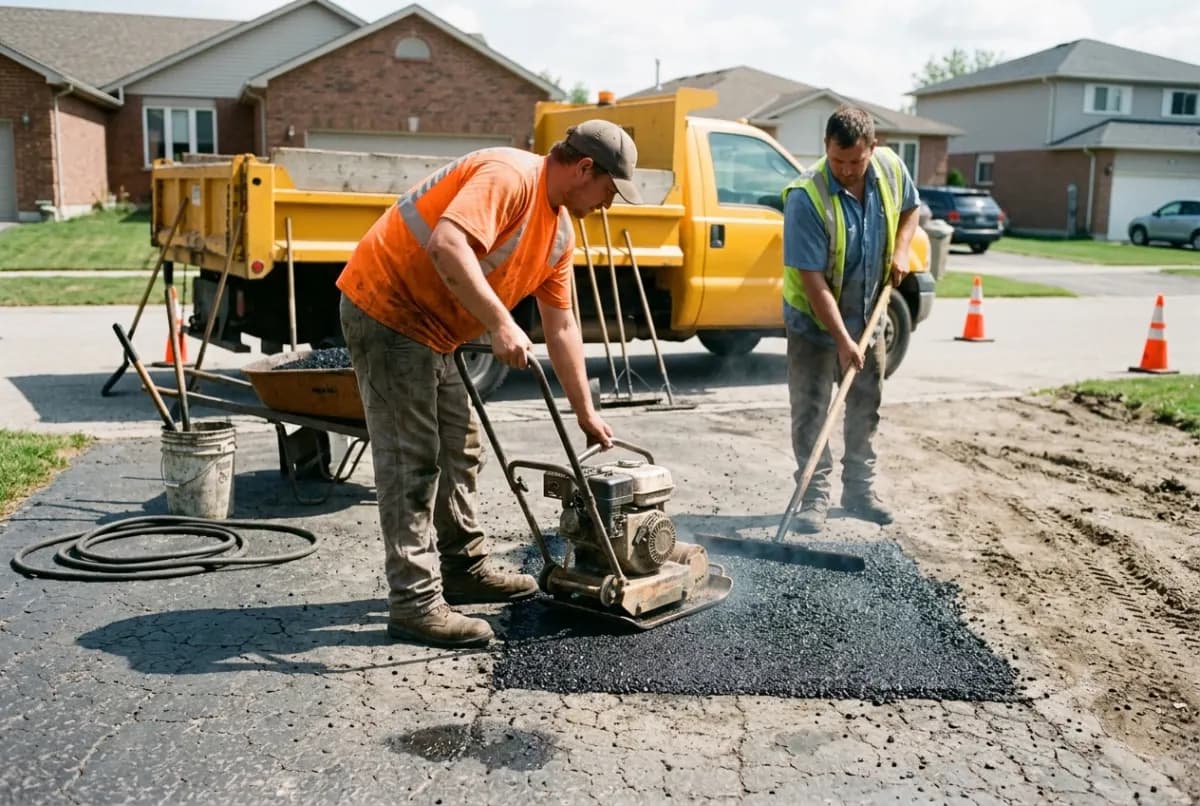
Start with at least three written estimates. Give each company the same job description, then compare the proposed construction details alongside the final price. Before signing, verify insurance and any license required by your state or local government.
The contract should cover the paved area, preparation, compacted thickness, drainage, schedule, payment terms, warranty, and change orders. FTC consumer guidance also flags high-pressure offers, requests for cash or wire transfers, and the familiar claim that a crew has material left from another job.
Step 1: Define the job before requesting prices
Write a one-page scope with:
- address and contact information.
- approximate paved area and sketch.
- new installation, replacement, overlay, or repair.
- current surface and visible distress.
- drainage problems and desired changes.
- vehicles that will use the pavement.
- access restrictions.
- preferred construction window.
- permit or right-of-way questions.
This does not replace the contractor's design. It gives each company the same starting point, reducing false price differences.
Step 2: Build a verifiable shortlist
Look for established local companies whose work matches the project type. Residential driveways and engineered commercial lots need different planning and equipment.
For each company, verify:
- legal business name.
- physical business address when applicable.
- working phone and domain-based email.
- how long the business has operated under that name.
- references for similar recent work.
- current liability insurance certificate.
- workers' compensation coverage where required.
- contractor or home-improvement license if your jurisdiction requires one.
- permit responsibility.
Do not rely only on a logo, social profile, screenshot, or certificate handed to you. Contact the insurer or issuing authority using independently located information. Licensing requirements vary; check the state contractor regulator and local building or public-works department.
Step 3: Compare complete scopes
Price per square foot is meaningful only when the underlying work matches.
| Item | Minimum useful detail |
|---|---|
| Area | Measured square footage and marked limits |
| Removal | Material, depth, hauling, and disposal |
| Subgrade | Grading, soft-area treatment, and compaction |
| Base | Type and compacted thickness |
| Asphalt | Mix/lifts and compacted thickness |
| Drainage | Planned slope, structures, and discharge |
| Edges | Edge detail and shoulder/backfill |
| Transitions | Garage, street, sidewalk, curb, and utilities |
| Protection | Buildings, landscaping, concrete, and vehicles |
| Access | Closure time and reopening instructions |
| Warranty | Written coverage, term, exclusions, and claim method |
If one bidder proposes an overlay and another proposes full reconstruction, do not rank them as three prices for the same solution. Ask each contractor to explain the diagnosis, intended service, and alternatives.
Step 4: Ask technical questions in plain language
Use these questions verbatim:
- What do you believe caused the current failures?
- How will you evaluate soft or wet areas after removal?
- What base material and compacted thickness are included?
- What asphalt mixture and compacted thickness are included?
- Is that one lift or multiple lifts, and why?
- How will the finished surface drain at the garage, street, and property edge?
- Who handles permits, utility conflicts, and right-of-way work?
- What is the unit price if unexpected excavation or stone is needed?
- When can people, vehicles, delivery trucks, and trailers use the pavement?
- What must I do to preserve the warranty?
Good answers should be specific to the site. Be cautious when every problem is answered with a coating, thin cap, or unexplained “industry standard.”
Step 5: Verify references intelligently
Ask for projects completed recently and projects old enough to show performance. With permission, inspect:
- drainage after rain.
- edges and transitions.
- settlement at garage or street.
- recurring cracks.
- cleanup and landscape restoration.
- whether the final invoice matched authorized work.
Ask references how the company handled schedule changes, hidden conditions, callbacks, and warranty concerns. A driveway that looked good on installation day does not tell you much about the follow-up service.
Online reviews are useful as pattern evidence. Read recent low and middle ratings, company responses, and repeated issues. Do not treat rating count as proof of insurance, licensing, technical competence, or honest scope.
Step 6: Put the agreement in writing
The contract should identify:
- legal names and site address.
- exact work limits and attached plan/sketch.
- materials and compacted thicknesses.
- demolition, disposal, and restoration.
- drainage and elevation responsibilities.
- start window and estimated duration.
- weather and delay terms.
- total price and allowances.
- written change-order process.
- payment schedule.
- cleanup and property-protection duties.
- proof of insurance and permit responsibility.
- warranty and exclusions.
- cancellation rights required by applicable law.
Avoid empty spaces. Keep the signed contract, proposal, certificate, product sheets, change orders, photos, messages, and proof of payment.
Payment safeguards
- Do not pay cash solely because a discount is offered.
- Do not wire money to an unfamiliar person or account under pressure.
- Avoid full payment before work is complete and inspected.
- Tie progress payments to visible milestones defined in the contract.
- Make the payee match the contracting business.
- Get written receipts and lien waivers where appropriate.
- Confirm local deposit limits or home-improvement contract rules.
Payment practices and lien law vary by jurisdiction. For a large project, consider local legal advice rather than relying on a generic percentage rule.
High-risk warning signs
- “We have asphalt left from another job.”
- Pressure to decide immediately.
- No written scope or measured area.
- Unmarked truck or business identity that cannot be verified.
- Request for cash, gift cards, cryptocurrency, or wire transfer.
- Price far below comparable scopes with no technical explanation.
- Refusal to provide current insurance evidence.
- Vague thickness stated without saying compacted thickness.
- Claims that permits or local requirements “never matter.”
- Large surprise change order without photos, quantities, unit prices, and written authorization.
- Promise that asphalt or concrete will never crack.
FTC guidance specifically highlights unsolicited offers involving leftover materials and pressure tactics as home-repair scam patterns.
About door-to-door cancellation rights
The FTC Cooling-Off Rule can provide a three-business-day cancellation right for certain sales made at a consumer's home or other temporary locations, but exceptions and transaction requirements apply. State law may add protections. Do not assume every paving contract can be canceled under the rule; review the contract and current law or seek qualified advice.
Final inspection checklist
Before final payment, compare the finished work with the contract:
- limits and dimensions match.
- surface drains as designed.
- garage, sidewalk, curb, and street transitions are safe.
- drains and utility covers function.
- edges and shoulders are completed.
- buildings and concrete are clean.
- debris and excess materials are removed.
- access and care instructions are in writing.
- warranties, receipts, lien documents, and permit closeout are delivered.
Some drainage defects are easiest to see during rain. If practical and contractually permitted, preserve a reasonable final acceptance process rather than relying only on same-day appearance.
Sources and methodology
- FTC: How to avoid home-repair scams
- FTC: How to avoid a home-improvement scam
- FTC: Cooling-Off Rule overview
- FTC: Cooling-Off Rule legal resources
- Illinois Asphalt Pavement Association: Driveways
Editorial note: Consumer-protection and licensing rules change by jurisdiction. Verify current local requirements before signing.
Frequently asked questions
- How many paving quotes should I get?
- At least three written estimates is a sound consumer-protection baseline. A fourth may help when proposed scopes differ widely.
- Does a paving contractor need a license?
- It depends on state, county, city, project value, and work type. Verify requirements with the applicable regulator. Do not accept a generic "licensed and insured" claim without checking.
- How much deposit is normal?
- There is no safe universal percentage. Contract rules and deposit limits vary. Keep payment proportional to documented progress, avoid full prepayment, and verify local requirements.
- Is a workmanship warranty enough?
- Only if it defines covered defects, duration, exclusions, response process, and remedy. Ask how drainage, base failure, cracking, settlement, weeds, fuel spills, snowplows, and heavy vehicles are treated.