Asphalt vs. Concrete Driveway
By Derek Garvey · Reviewed July 2026 · National planning ranges, not quotes · Questions or corrections: admin@pavingcalc.com
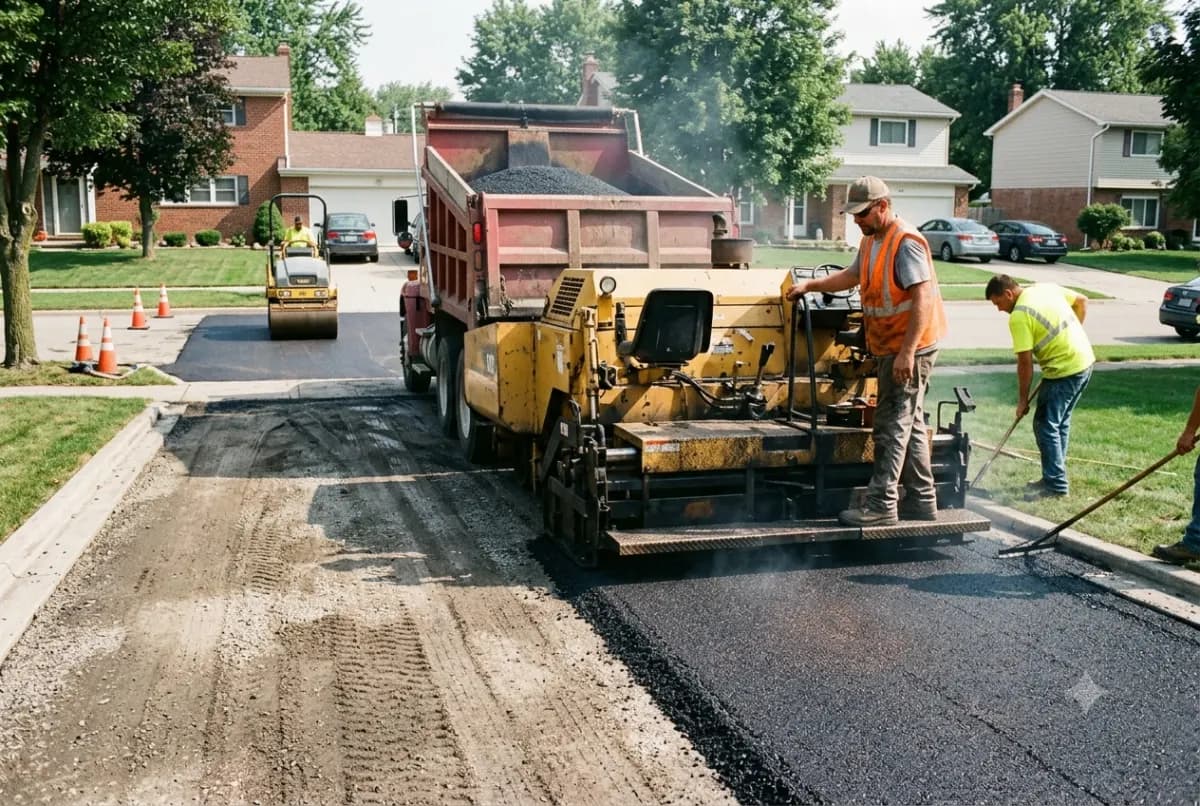
Asphalt usually costs less up front and is easier to resurface later. Concrete costs more in most markets, but it offers a lighter surface and more choices for color and finish. Those are useful differences. They still do not tell you which material will perform better on a particular property.
Neither material wins every climate. A properly drained, well-built driveway can perform well in hot or cold weather. Poor soil preparation or sloppy construction can ruin either one.
Side-by-side comparison
| Factor | Asphalt | Concrete |
|---|---|---|
| Typical initial price | Often lower | Often higher |
| Structure | Flexible pavement | Rigid slab |
| Surface color | Dark; absorbs more solar heat | Light gray unless colored |
| Construction | Compacted hot-mix layers over prepared support | Placed, finished, jointed, and cured |
| Opening | Often sooner, subject to contractor instructions | Requires protected curing and strength gain |
| Maintenance | Crack treatment, occasional surface treatment, possible overlay | Joint maintenance, crack/spall repair, possible sealing depending exposure |
| Major renewal | Milling/overlay may be practical if base is sound | Individual slab replacement or more extensive removal |
| Decorative choices | Limited color/texture options | Broad finish, color, and pattern options |
| Visible fluids | Oil may be less visually obvious | Oil and rust may be more visible |
| Winter details | Flexible but still vulnerable to water and freeze-thaw | Air entrainment, drainage, curing, and deicer practice are critical |
Current cost context
Current national consumer publishers often place standard asphalt around $5-$13 per square foot for new installation and concrete in a broad range around $8-$20 per square foot, depending on finish and project conditions. These ranges overlap and vary by market. Demolition, base reconstruction, reinforcement, drainage, access, color, stamping, and small-job minimums can dominate the total.
For a 600-square-foot driveway:
- Asphalt scenario at $5-$13: $3,000-$7,800
- Concrete scenario at $8-$20: $4,800-$12,000
Do not compare these totals until both bids include the same removal limits, subgrade work, drainage, area, transitions, and restoration.
How the systems differ
Asphalt is a flexible pavement
Asphalt distributes loads through compacted layers and can accommodate small movements, but it still needs adequate support and drainage. The proposal should define compacted base and asphalt thicknesses. A thin black surface over unstable wet soil will not perform like a properly designed pavement.
Concrete is a rigid pavement
Concrete spans and distributes loads as a slab. Thickness, subgrade support, mixture, air entrainment where freeze-thaw exposure exists, joint layout, finishing, and curing all matter. Cracking cannot be guaranteed away; properly planned joints encourage cracks to occur at controlled locations.
American Cement Association guidance describes residential driveway slabs commonly around four to five inches, with project-specific adjustments. It also recommends reasonably square joint panels and cautions against long narrow panels. The local contractor or designer must set the final section.
Climate: replace slogans with specifications
Cold and freeze-thaw regions
Both materials need drainage and stable support. For concrete exposed to freezing and moisture, proper air entrainment, water-cement ratio, finishing, curing, and deicer practices are important. NRMCA cautions against deicing chemicals during the first winter because young concrete is more susceptible to scaling.
Asphalt can tolerate some movement, but trapped water, weak base, snowplow damage, and freeze-thaw action can still cause cracks and potholes. Crack treatment does not solve recurring water or base problems.
Hot regions
Dark asphalt absorbs heat and can soften under severe temperatures and concentrated loads, especially during early service or if the mixture and structure are unsuitable. Concrete stays lighter in color but can still crack, move at joints, and suffer construction-related defects.
Salt and coastal exposure
Deicers and salts can affect concrete durability, reinforcement, adjacent landscaping, and drainage systems. Asphalt is not immune to chemical spills or water intrusion. Specify materials for local exposure rather than choosing from climate shorthand.
Maintenance and repairability
Asphalt
Inspect cracks, edges, drainage, depressions, and raveling. Treat defects while they are localized. Sealcoating may be appropriate after the surface ages and shows need; Asphalt Institute says a properly built new low-volume pavement should not normally need it for about two to five years. An overlay can renew a structurally suitable driveway, but existing cracks may reflect through.
Concrete
Keep joints functioning and drainage clear. Repair isolated spalls or cracks with compatible methods. Slab replacement can produce color differences. Surface sealers may be useful for particular exposures, but they do not substitute for suitable mixture, curing, and drainage.
Appearance and property use
Concrete offers broom, exposed-aggregate, colored, and patterned finishes. Decorative work raises price and makes repairs harder to blend. Asphalt offers a consistent dark surface and visually forgiving patches, but it has fewer decorative options.
Consider actual use:
- Frequent heavy delivery or RV parking may require a stronger section.
- Tight stationary steering stresses either surface.
- Kickstands, jacks, and narrow trailer feet can indent hot asphalt.
- Snowplows can damage raised edges or poorly aligned slabs.
- Garage thresholds, sidewalks, and street aprons may constrain finished elevation.
Environmental and drainage choices
Traditional asphalt and concrete are impervious. Runoff must be routed safely. Permeable asphalt, pervious concrete, and permeable pavers are system designs that include a water-storing stone reservoir and suitable outlet or infiltration conditions. They are not created by substituting a porous top layer over a conventional base.
Both industries use recycled materials in some mixtures. Ask about the actual product, local specification, durability evidence, haul distance, and end-of-life plan rather than accepting broad “green” claims.
Decision scorecard
Choose asphalt more often when:
- initial budget is the strongest constraint.
- you want faster conventional installation.
- future milling or overlay is attractive.
- a dark, simple surface fits the property.
- qualified asphalt contractors and plants are readily available.
Choose concrete more often when:
- you want a light or decorative surface.
- a rigid slab is appropriate for the site and loads.
- you accept a higher initial cost.
- joints and curing can be protected properly.
- qualified finishers can execute the specified work.
Get both options designed to comparable service expectations. Comparing a minimal asphalt section with premium reinforced decorative concrete is not a material comparison.
Questions to ask both bidders
- What existing material is removed?
- How will subgrade and soft areas be evaluated?
- What compacted base and pavement thickness is included?
- How will water drain at the garage, street, and property lines?
- What mixture, reinforcement, or joint details are proposed?
- What weather limits and curing/protection steps apply?
- When can people, cars, trucks, and snow equipment use it?
- What maintenance is expected in years 1, 5, and 10?
- What does the warranty exclude?
Sources and methodology
Illinois Asphalt Pavement Association: Driveways · American Cement Association: Applications of cement and concrete · American Cement Association: Concrete floors and slabs guidance · NRMCA: CIP 2, Scaling concrete surfaces · Angi: Asphalt driveway cost · Angi: Concrete driveway cost
Editorial note: Sources and price ranges were reviewed July 21, 2026. Obtain site-specific designs and local bids.
Frequently asked questions
- Which lasts longer?
- Concrete is often assigned a longer design or service life in general comparisons, but a precise lifespan cannot be promised from material alone. A well-built, drained pavement can outlast a poorly designed "long-life" material.
- Is asphalt always better in a cold climate?
- No. Asphalt's flexibility can be useful, while properly designed air-entrained concrete also performs in freeze-thaw climates. Soil, drainage, materials, workmanship, joints, curing, and winter maintenance decide outcomes.
- Can concrete be placed over asphalt or asphalt over concrete?
- Sometimes, but only after evaluating elevations, drainage, movement, bond/separation, and structural condition. Do not assume the existing surface is a suitable base.