Asphalt Driveway Thickness & Base
By Derek Garvey · Reviewed July 2026 · National planning ranges, not quotes · Questions or corrections: admin@pavingcalc.com
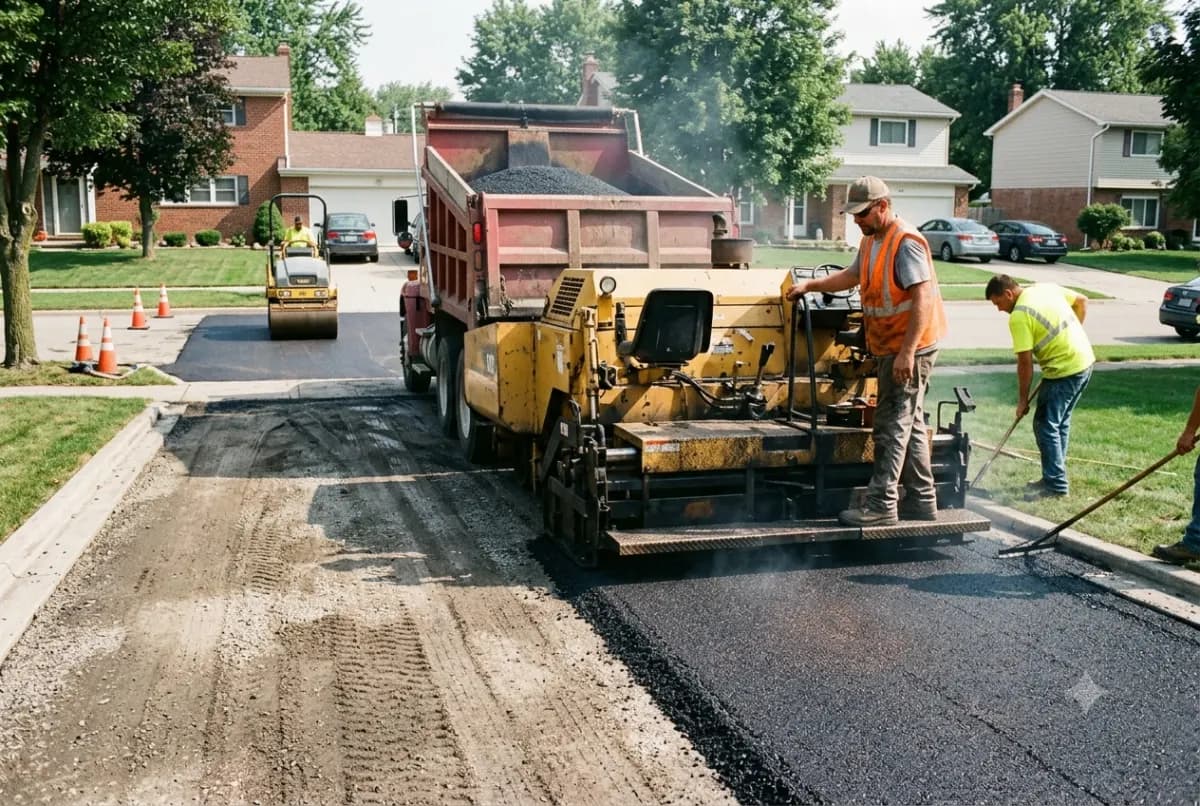
There is no single asphalt thickness that works for every driveway. Soil and drainage matter. So do the vehicles that will use it, the local climate, the asphalt mix, and how the contractor plans to place it. A useful proposal spells out the subgrade work, compacted base thickness, asphalt mix, number of lifts, and compacted asphalt thickness.
Treat a bid that says only “two inches of asphalt” as incomplete until it explains whether that is loose or compacted thickness and what supports it.
The pavement is a system
From bottom to top, a conventional driveway may include these parts:
| Part | What it does |
|---|---|
| Subgrade | Existing or improved soil supports the pavement. |
| Separation or stabilization | Geotextile, geogrid, lime/cement treatment, or undercut may be used when the site calls for it. |
| Aggregate base | Crushed material is placed and compacted in controlled layers. |
| Asphalt base, binder, and surface | Plant-produced mix is placed hot and compacted to the specified thickness and density. |
| Edges and drainage | Shoulders, curbs, swales, and transitions keep the section supported and dry. |
The black surface cannot compensate for saturated soil or an inadequately compacted foundation.
Published examples, not universal specifications
Illinois Asphalt Pavement Association guidance gives homeowners two example approaches:
- about 4 inches of full-depth asphalt may be adequate for many driveways, with 5-6 inches providing more strength; or
- about 6-8 inches of compacted aggregate base with approximately 3 inches of asphalt.
These are examples from an industry association, not a substitute for local design. Frost depth, weak soils, steep slopes, truck use, local materials, and municipal apron requirements can justify a different section.
FHWA low-volume pavement guidance similarly ties structural design to subgrade, traffic, environment, materials, and drainage. Ask bidders what assumptions produced their recommendation.
Loose thickness versus compacted thickness
Asphalt and aggregate become thinner as rollers compact them. A proposal should state the finished compacted thickness and clarify any loose-depth measurement used during placement.
Ask:
- Is the thickness compacted?
- Is it an average or minimum?
- How many lifts will be placed?
- What is the mixture’s nominal maximum aggregate size?
- How will density or compaction be controlled?
- How will thickness be verified if there is a dispute?
The Alabama Asphalt Pavement Association design guide emphasizes compacted thickness and matching lift thickness to mixture aggregate size. Very thick single lifts or extremely thin lifts can be unsuitable for the mixture and equipment.
What determines the section
Soil support
Firm, uniform, well-drained soil needs less structural help than soft clay, fill, organic material, or soil that pumps under load. Construction may require proof rolling, test pits, compaction testing, undercutting, stabilization, or geosynthetics.
Water
Water reduces support and contributes to frost and settlement. The pavement surface, base, edges, roof downspouts, and surrounding grade must work together. Adding asphalt thickness without correcting trapped water may only delay visible failure.
Vehicles
Passenger cars differ from RVs, delivery trucks, garbage trucks, landscaping trailers, and construction equipment. Load frequency, axle weight, slow turns, braking, and parked point loads matter. Tell the contractor how the driveway will actually be used.
Climate
Freeze-thaw cycles, prolonged heat, rainfall, groundwater, and seasonal construction windows affect materials and design. Local specifications and experienced contractors are more useful than a national rule.
Existing structure
An overlay relies on the existing pavement. Cores, probes, and test pits may be warranted when thickness and base condition are unknown. Extensive cracks, rutting, or movement can make an overlay a short-lived cosmetic solution.
Aggregate base details
A good scope identifies:
- aggregate type and gradation.
- compacted thickness.
- placement in manageable layers.
- moisture and compaction approach.
- edge confinement.
- treatment of soft or yielding areas.
- final grade before paving.
“Add stone as needed” creates cost and quality ambiguity. If hidden conditions are possible, require a unit price per ton or cubic yard, estimated allowance, photographic documentation, and written authorization.
Full-depth asphalt versus aggregate-base design
Full-depth asphalt
This design places asphalt layers directly over prepared subgrade. It can provide a strong structure with fewer material interfaces, but it still needs suitable soil, drainage, and compaction.
Aggregate base plus asphalt
This design is common and can be economical where quality aggregate is available. The base must be well graded, compacted, confined, and protected from water.
Neither approach is automatically superior. Compare structural intent, local materials, contractor capability, and site conditions.
One lift or multiple lifts?
Multiple asphalt lifts can allow different mixtures, better compaction through controlled layer thickness, and a surface course selected for finish and durability. A single lift may be appropriate for some residential sections and equipment setups. The answer depends on total thickness, aggregate size, placement conditions, and specification.
Ask why the proposed lift plan fits the mixture rather than requiring a canned number.
Edges and transitions
Unsupported edges can crack and break when tires run near them. The contractor should explain:
- whether edges are confined by curb, shoulder, or backfill.
- how the surface meets garage slabs, sidewalks, and street pavement.
- whether water can enter at the transition.
- how added thickness affects doors, siding, steps, and curb reveal.
- when shoulder/backfill will be completed.
Avoid driving near new unsupported edges until the contractor authorizes use and edge support is complete.
Proposal comparison table
| Specification | Bidder A | Bidder B | Bidder C |
|---|---|---|---|
| Measured area | |||
| Removal depth | |||
| Subgrade treatment | |||
| Aggregate type | |||
| Compacted base thickness | |||
| Asphalt mix/lifts | |||
| Compacted asphalt thickness | |||
| Drainage plan | |||
| Edge detail | |||
| Extra-work unit prices | |||
| Warranty/exclusions |
Red flags
- Thickness described only as “before compaction.”
- No base or subgrade description.
- Same section promised for cars and repeated heavy trucks without discussion.
- Water problems dismissed as cosmetic.
- Asphalt placed over moving, muddy, or frozen support.
- Unpriced “extra stone as needed.”
- No plan for garage, sidewalk, curb, or street elevations.
- Guarantee that the driveway will never crack.
Sources and methodology
- Illinois Asphalt Pavement Association: Driveways
- Alabama Asphalt Pavement Association: Asphalt Pavement Design Guide
- FHWA: Low-volume road pavement design considerations
- Asphalt Magazine: What makes a good asphalt driveway?
Editorial note: Examples are educational. Final thickness and materials should follow site conditions, local requirements, and qualified design.
Frequently asked questions
- Is two inches of asphalt enough?
- The phrase is incomplete. It does not define compacted thickness, base, soil, traffic, mixture, or drainage. It may be part of a suitable design in some settings and inadequate in others.
- Does thicker always mean better?
- Not by itself. Thickness must be placed in compatible lifts over prepared support and compacted correctly. Drainage and construction quality remain essential.
- Do I need geotextile fabric?
- Not automatically. Geotextiles can provide separation or other functions in suitable designs, but they do not turn soft wet soil into a sound foundation by themselves. Ask what problem the proposed product solves.
- How can thickness be verified?
- Methods can include documented yield, depth checks during construction, and cores after placement. Agree on the specification and verification method before work.