Asphalt Driveway Drainage & Slope
By Derek Garvey · Reviewed July 2026 · National planning ranges, not quotes · Questions or corrections: admin@pavingcalc.com
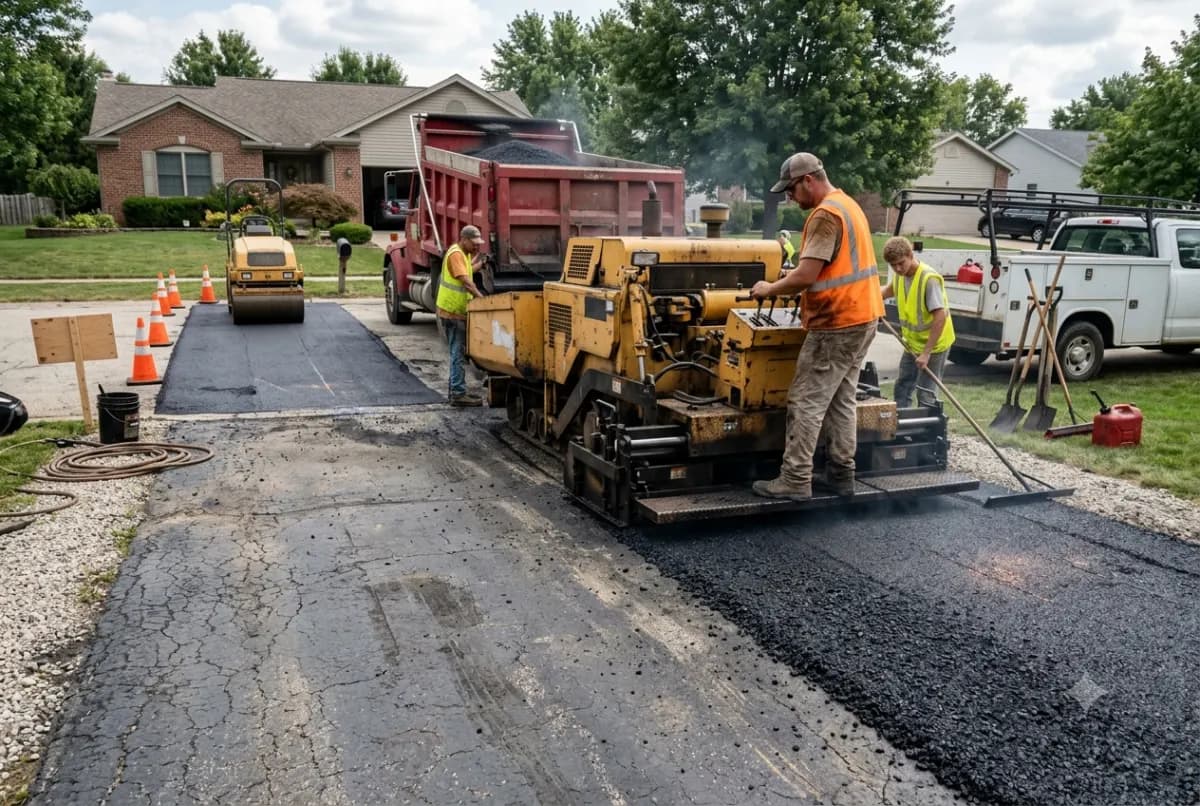
A driveway needs to move water away from the garage, foundation, and pavement base, then release it somewhere safe and lawful. That route should be settled before anyone sets the paving elevations. Otherwise, fresh asphalt can leave the original drainage problem in place or make it worse.
Asphalt-industry guidance often uses about 2% slope, roughly 1/4 inch per foot, as a practical target where the site allows it. That number is not a universal residential code. Existing elevations, accessible routes, steep sites, public aprons, and local drainage rules can require a different design.
Why pavement water causes damage
Water on the surface creates ponding, spray, algae, winter ice, and nuisance runoff. Water inside the pavement system can reduce soil and base support. Repeated loads then cause movement, cracking, rutting, and potholes.
Common entry paths include:
- open cracks and joints.
- unsealed transitions.
- low unsupported edges.
- roof downspouts.
- uphill runoff.
- blocked swales or drains.
- permeable shoulders that direct water under the pavement.
- high groundwater.
Sealcoating cannot correct a saturated base or reverse the driveway’s slope.
Understanding grade, slope, and crossfall
Slope percentage is:
Slope (%) = vertical change ÷ horizontal distance × 100
Examples:
| Vertical change | Horizontal distance | Approximate slope |
|---|---|---|
| 3 in. | 10 ft. | 2.5% |
| 6 in. | 25 ft. | 2.0% |
| 12 in. | 50 ft. | 2.0% |
Convert units first: 10 feet is 120 inches, so 3 ÷ 120 × 100 = 2.5%.
Longitudinal slope follows the driving direction. Cross slope or crossfall moves water sideways. A driveway may use one or both. The surface must also transition safely at the garage, sidewalk, street, and accessible route.
Common drainage layouts
Crowned driveway
The center is higher and water sheds to both edges. This can work on wide or rural drives with stable, lawful side drainage. Edges need support, and water must not erode shoulders.
One-way crossfall
The entire surface slopes toward one side. It is simple but needs a receiving swale, drain, or stable area that can handle the flow.
Valley or swale
A shallow channel directs water along or across pavement. It must be driveable, maintainable, and free of abrupt grade changes that scrape vehicles.
Trench or channel drain
A drain near a garage or low point can intercept water when gravity alone cannot protect the building. It needs adequate capacity, a legal outlet, cleanouts, freeze protection where relevant, and routine maintenance. A drain without an outlet is only storage.
Culvert
Where a driveway crosses a roadside ditch, the culvert size, material, cover, end treatment, and permits may be controlled by the road authority. Do not pave the apron until required inspection and elevation checks are complete.
Design from the fixed points
Identify elevations that cannot move easily:
- garage slab and door.
- foundation and siding clearance.
- public sidewalk.
- curb or roadway edge.
- utility covers.
- existing drains and pipe outlets.
- neighboring grades.
- accessible routes.
- retaining-wall tops and bottoms.
An overlay raises the surface. Even a modest added thickness can reduce clearance, flatten drainage, create a lip at concrete, or send water into the garage. Milling may be required to preserve elevations.
Field drainage audit
Perform this before requesting final bids:
- Observe the site during steady rain.
- Photograph water flow and ponding.
- Mark high points, low points, and discharge locations.
- Trace roof downspouts and sump-pump outlets.
- Note sediment, erosion, algae, ice history, and wet shoulders.
- Identify utilities and structures that constrain grade.
- Ask whether runoff leaves the property legally and safely.
Do not redirect water to a neighbor, public sidewalk, roadway, septic field, or foundation without checking local rules and consequences.
How paving proposals should address drainage
Require written answers:
- What direction will water flow?
- What approximate finished slopes are intended?
- Where are the high and low points?
- Will milling, excavation, or elevation changes be needed?
- How are garage and street transitions protected?
- Are swales, drains, culverts, or underdrains included?
- Who connects and maintains the outlet?
- How are roof and uphill flows handled?
- What happens if hidden grades or utilities prevent the plan?
- How will the finished drainage be checked?
“Pitch as needed” is not a useful scope for a site with known water problems.
Ponding: what is acceptable?
Do not use an arbitrary online depth-and-duration rule without tying it to the contract and governing specification. Surface texture can retain a thin film after rain, while a depression that remains after surrounding pavement drains is different.
Before construction, define the acceptance method:
- timing after rainfall or controlled water test.
- measurement tolerance.
- excluded areas such as textured transitions.
- repair process.
- who decides whether discharge is functioning.
Commercial or engineered projects may have formal smoothness and drainage criteria. Residential contracts often need these expectations written explicitly.
Steep driveways
Steep sites require more than choosing a percentage. Consider:
- vehicle traction and winter ice.
- safe sight distance at the street.
- vertical curves that prevent bottoming out.
- runoff velocity and erosion.
- cross-slope stability.
- paver and roller access.
- garage transition.
- local maximum grades and permit standards.
Local regulations vary. A survey and civil design may be appropriate where the grade is steep, drainage crosses property lines, or the driveway connects to a public road.
Maintenance that preserves drainage
- Keep inlets, trench drains, swales, and culverts clear.
- Redirect roof water to a designed outlet.
- Repair eroded shoulders before edges lose support.
- Treat cracks using suitable methods before water enlarges them.
- Prevent landscaping and soil from building above pavement edges.
- Inspect after major storms, utility work, and freeze-thaw seasons.
- Do not place sealcoat so thick that it blocks small drainage paths.
Warning signs requiring professional review
- Water enters a garage or foundation.
- Runoff crosses a public sidewalk or freezes on the street.
- The base pumps water or fine material through cracks.
- A retaining wall or steep slope is moving.
- A culvert repeatedly overtops.
- Drainage would be discharged onto neighboring property.
- A low point has no gravity outlet.
- An accessible route may be affected.
Sources and methodology: Asphalt Magazine: Keys to top-performing parking lots, Asphalt Magazine: What makes a good asphalt driveway?, FHWA: Urban drainage design manual, Illinois Asphalt Pavement Association: Driveways. Editorial note: Drainage can affect buildings, public infrastructure, and neighboring properties. Use qualified local design when consequences extend beyond routine surface grading.
Frequently asked questions
- Is 2% slope always required?
- No. It is a common drainage target where geometry allows, not a universal rule for every driveway. Local code, fixed elevations, accessibility, and site engineering control.
- Can a channel drain solve a flat driveway?
- Only if it is correctly sized, placed, connected to a lawful outlet, and maintained. It cannot compensate for every grading problem.
- Will an asphalt overlay fix ponding?
- It can reprofile some areas, but added thickness can also worsen transitions or trap water. The contractor should provide an elevation and milling plan.
- Should downspouts empty onto the driveway?
- Usually it is better to route roof water through a designed system that does not saturate or erode the pavement edge. The correct outlet depends on local rules and property conditions.